
in the imaginary dialogue between thelonious monk and the shade of james p. johnson. . .
By Benjamin Goluboff and Mark Luebbers
Art by Warren Linn
. . .The signal-to-noise ratio would have favored noise. Wow and flutter, bop and rebop, static and warp would have deviled the line from the Palisades to the old block, connection dropping in and out, sense chasing nonsense, but Mr. Johnson was no doubt present and accounted for and talking to Monk.
Monk would have heard the composer’s shade or alibi in bits and pieces whenever he looked at the Midtown skyline from Nica’s* big windows over the Hudson. James P. was somehow on the air there, on Monk’s frequency if nobody else’s, presiding in Nica’s share of sky. And since Nica’s share of sky was more or less the sky over San Juan Hill across the river, Johnson would have been talking about the old neighborhood now erased by renewal. It was called San Juan Hill not just because the Puerto Ricans had lived there with the blacks and the last of the working-class Irish, but because of all the shooting all the time in the bars and jukes and alleys and houses, like it was people’s job to be shooting, like it was Teddy and the Rough Riders shooting their way up San Juan Hill.
So the two musicians (one made of flesh, the other the voice of the windows) would have reflected on the old neighborhood, how it was fled away like Horatian snow, on the leveling of the Hill to make the Amsterdam Houses and Lincoln Center: the Temple of Culture built on the wreckage of the Jungle.
Alice Tully was the opera singer, right? Mr. Johnson, his shade or alibi, might have asked, but who is Avery Fisher? And it might have occurred to Monk that he didn’t know either: Rich fellow, I suppose. Patron of the arts. As they talked on, their dialogue like tin cans and string across the Hudson or a shadow bridge from the Jersey side to the underworld, it was inevitable that Monk and Johnson would have addressed themselves to the style.
Even from his position of great detachment Johnson may not have understood that it’s easier to father a style than to be one of the stylists who gets fathered. Johnson’s paternity was everywhere undisputed and the players who followed the old man’s stride were left fiddling at diminishing returns.
Now, Monk might not have considered his returns to be all that diminished but it was clear, even through the static over the Hudson, the wow and flutter, the bop and rebop, that Johnson felt Monk had dishonored the style.
The dead composer would have deplored Monk’s strange attack, his vagaries, his way of following some thematic scent through the piece till it was lost in a thicket or streambed and you wondered what he was chasing in the first place.
And the dancing! Johnson, his shade, or alibi would have deplored the dancing: Strutting your ungainly ass around the stage. What are you thinking up there, son? Johnson might have asserted that the style is father to the man and Monk might have wished himself unfathered, to style himself progenitor and origin as if the whole thing started with him, with Monk, but what he said or might have said is that the style develops, Mr. Johnson, sir. Younger cats. Newer times. The style grows up.
So they would have gone back and forth, the ghost and the musician, the patriarch and the prodigal, Abraham and Ishmael, their dialogue interrupted and continuous, recurring as if it had never been suspended whenever Monk took in the view of Midtown through Nica’s windows.
And as they went back and forth, tuning and parsing the character and fate of the style, it would have been like the right and left on the keys: the left on the beat, the right anticipating, the left striding across the downstairs, the right upstairs chopping and looping the melody. The left says tonic, the right says dominant, the left sounds the tenth, the right asserts a legato exploration of the chord leaving the root tone unvoiced.
But the analogy only goes so far because, unlike Monk and Mr. Johnson, the left and right are not properly in dialogue, do not achieve synthesis, are not mutually engaged in a harmonic scheme of tension and release. There is no two-ness, no hic et ille. The left and right are a single implement of the style, have single being in the style like drops in the bucket or God in the Host.
Now Mr. Johnson had all the time in the world, and then some, to discourse and discuss, to grind fine and small, to batter the younger musician with that narrative of decline which the dead so love to relate, and Monk had only a few years left on the living side of the river, but this knowledge was a comfort to him. Monk understood, or would have understood, what Johnson would have forgotten: that the style belongs to the living who hold it in trust for the future, that the style is itself alive and bears no obligation to the dead who, while powerful in other ways, have no real say in the style.
*Baroness Kathleen Annie Pannonica “Nica” de (née Rothschild, 1913-1988) was a friend and patron of Jazz musicians
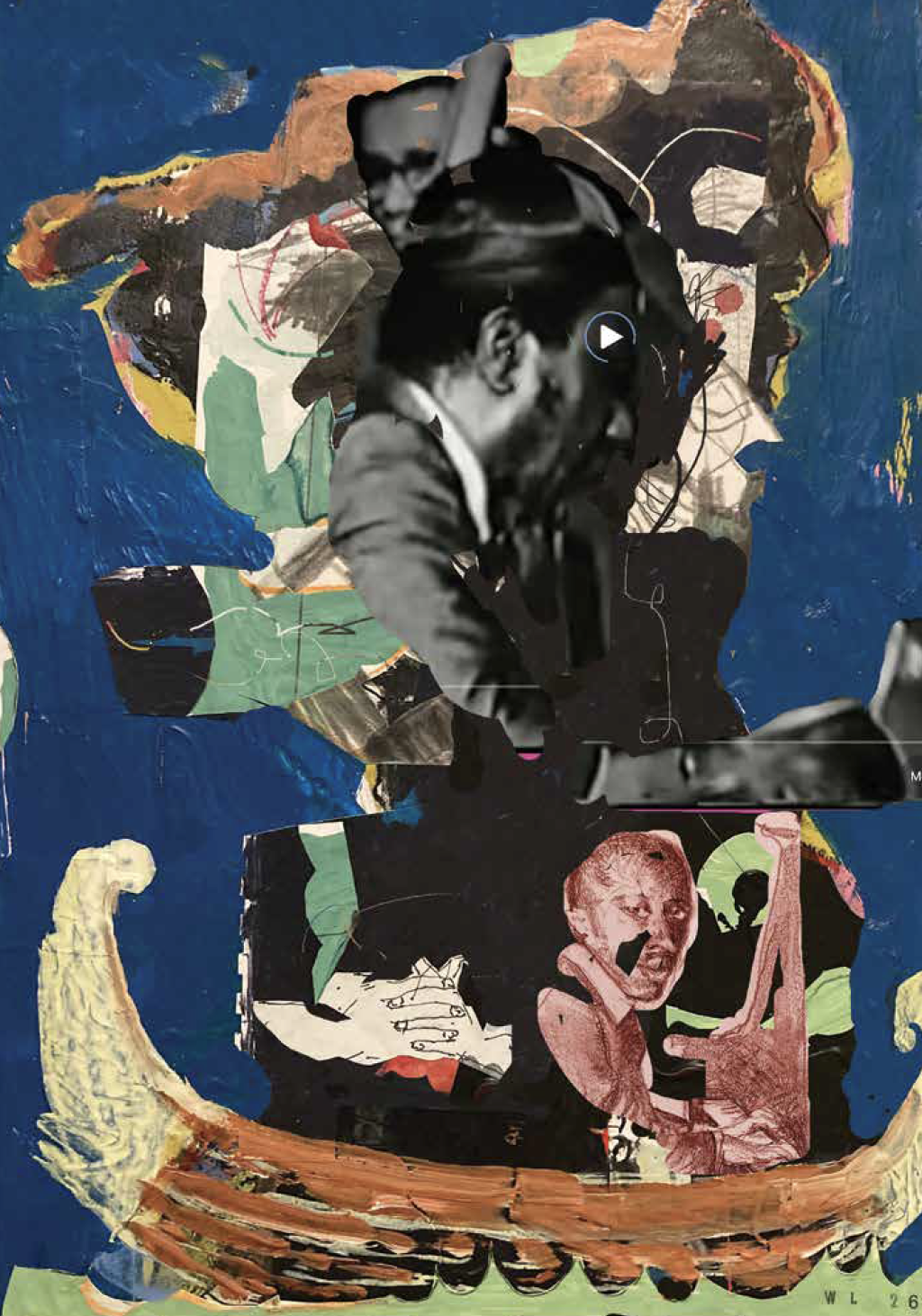
MonkJohnson, 2026. Mixed media and digital collage. Frame capture from Straight No Chaser, Charlotte Zwerin director, archival performance footage.
Ben Goluboff and Mark Luebbers have published their individual work in a number of journals and magazines as well as their own collections, but have also been writing collaboratively since the middle of the last decade. Together they've published poems in many journals as well as the anthology They Said: A Multi Genre Anthology of Contemporary Collaborative Writing, published by Black Lawrence Press. Their collection Citizens of Ordinary Time was published by Urban Farmhouse Press in 2023, and a chapbook, Group Portrait: Poems on a Photograph by Hermann Landshoff was published by Parisian Phoenix Press in 2025.
Warren Linn worked from the 1960s through 2010 as an illustrator and now limits his practice to music packaging, books, and gallery exhibitions. His work is in eighteen American Illustration annuals, the Print & Drawing Collection at the Art Institute of Chicago, the Pennsylvania College of Technology Permanent Collection, Crédit Mutuel de Bretagne, France, and numerous private collections.